





















Organizations managing traveling personnel or international operations today have access to an unprecedented volume of risk information. Geopolitical alerts, health advisories, security warnings, extreme weather updates, notifications of political instability: the flow of information is continuous, multi-channel, and often redundant. Yet organizations’ ability to translate this flow into timely and accurate operational decisions remains dramatically inadequate.
The latest data confirm a structural gap: while the vast majority of organizations recognize that rapidly detecting risks represents a competitive advantage, only a minority consider themselves actually capable of verifying risk information quickly enough to make operational decisions. This gap is not strictly a technological problem; it is a problem of process, expertise, and decision-making architecture that exposes organizations to growing legal liabilities.
The Evolution of the Regulatory and Legal Framework
Duty of Care, namely an organization’s legal and ethical obligation to take reasonable measures to protect the health, safety, and well-being of its employees, has undergone significant evolution over the past decade. International case law has progressively extended this obligation beyond the boundaries of the physical workplace, including environments to which employees are sent on behalf of the organization.
The ISO 31030:2021 standard, specifically dedicated to Travel Risk Management, provides a structured framework for the assessment, communication, and mitigation of risks associated with traveling personnel. Courts in different jurisdictions increasingly use this standard as a benchmark for assessing whether an employer has reasonably fulfilled its duty of care obligations. Organizations that are unable to demonstrate that they have adopted preventive measures proportionate to the risk are exposed to potentially devastating legal, reputational, and financial consequences.
Anatomy of a Systemic Vulnerability
The gap between risk detection and verification manifests itself across several dimensions. The first is speed: in a context where crises evolve within hours or minutes, many organizations take days to validate risk information and turn it into an operational directive. The second is quality: not all information sources have the same level of reliability, and the ability to distinguish signal from noise requires specialized analytical expertise that is often lacking within travel management teams.
The third dimension is contextualization: a risk alert relating to an entire country has limited operational value for a travel manager who must decide whether to authorize travel to a specific city. Granular, localized, and contextualized intelligence, capable of distinguishing between a safe neighborhood and a high-risk one, between a viable road route and a blocked one, is what separates an effective travel risk management program from a merely formal one.
The Interconnected Risks of 2026
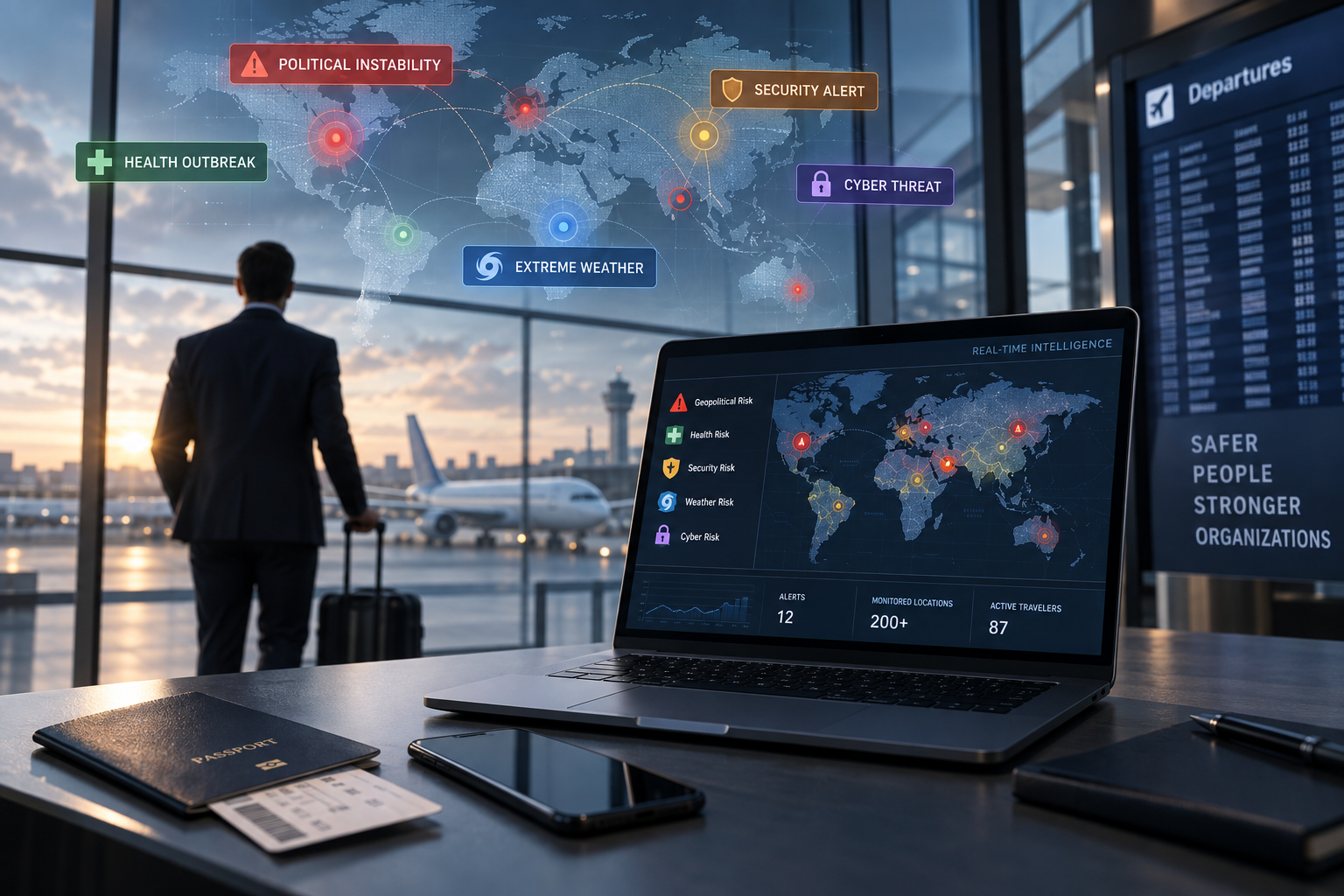
The risk landscape for traveling personnel in 2026 is characterized by increasing interconnectedness. Geopolitical instability remains the main driver of uncertainty, followed by cybercrime, political instability, and extreme weather events. But the greatest challenge does not lie in any single factor: it is the simultaneous management of overlapping risks that puts organizations to the test.
Business travel to a given region can simultaneously expose an employee to geopolitical, health, cyber, and infrastructure risks that influence one another. The sudden closure of borders due to political tensions may coincide with a disruption of digital communications, making it impossible to contact personnel in the field precisely when communication is most necessary. Organizations with crisis plans built around individual, isolated scenarios discover their inadequacy when reality presents combinations of simultaneous risks.
Building an Effective Decision-Making Framework
Overcoming this condition requires a rethinking of the entire decision-making architecture of travel risk management. The pillars of an effective framework include:
- reliable and diversified intelligence sources, prioritizing primary sources and local-language coverage;
- rapid verification protocols defining who validates information, according to which criteria, and within what timeframe;
- two-way communication tools with traveling personnel, capable of operating even when infrastructure is degraded;
- authorization and debriefing procedures that turn every trip into an opportunity for intelligence gathering for the organization.
Documenting every stage of the decision-making process is not merely good operational practice, but a legal necessity. In the event of an incident, an organization’s ability to demonstrate that decisions were made on the basis of verified information, through documented processes and within reasonable timeframes, can make the difference between an effective defense and exposure to significant liability.
Kriptia’s Support
Kriptia supports organizations through its Travel Security, Situational Awareness, and Early Warning services. Kriptia’s dedicated team produces granular and contextualized intelligence based on verified OSINT sources and enriched by direct knowledge of local environments provided by its global network of more than 200 professionals. KRION, its proprietary digital platform, enables real-time monitoring of risk conditions in areas of interest, the delivery of customized alerts, and two-way communication with traveling personnel. Kriptia also assists organizations in structuring Travel Risk Management programs compliant with the ISO 31030 standard, training traveling personnel, and defining crisis procedures tested through operational exercises.