
























The protection of corporate executives has historically relied on physical security measures: close protection teams, trained drivers, surveillance systems, and controlled access protocols. While these remain relevant, they are no longer sufficient in the face of a profound transformation in the nature of threats. In recent years, most attacks targeting senior executives no longer begin with physical intrusion, but with a digital reconnaissance phase that exploits the vast amount of personal information available online.
Recent research shows that the vast majority of corporate executives have significant exposure of sensitive personal data across online platforms: residential addresses, images of properties, information about family members, travel habits, and organizational affiliations. Consider professional platforms such as LinkedIn, where executives share their attendance at events, or Instagram, where they may tag vacation locations and hotels. Even seemingly harmless apps like Strava can geotrack personal fitness routines. This information—often scattered across data brokers, public records, social media, and datasets originating from past data breaches—forms the raw material for doxxing operations, targeted social engineering, stalking, and the planning of physical attacks.
OSINT as the First Line of Defense
Open Source Intelligence (OSINT) is now one of the most effective tools for anticipating threats directed at corporate executives. Unlike traditional security solutions, which are primarily reactive, OSINT enables organizations to map an individual’s digital exposure, identify anomalous interest patterns from hostile actors, and detect early warning signals before digital behavior translates into operational intent.
The intelligence process applied to executive protection follows structured phases: defining intelligence requirements based on the executive’s risk profile, systematically collecting information from open sources, filtering and organizing the data, conducting analytical interpretation to identify patterns and vulnerabilities, and finally disseminating actionable intelligence to protection teams.
Converging Threats: From Digital to Physical
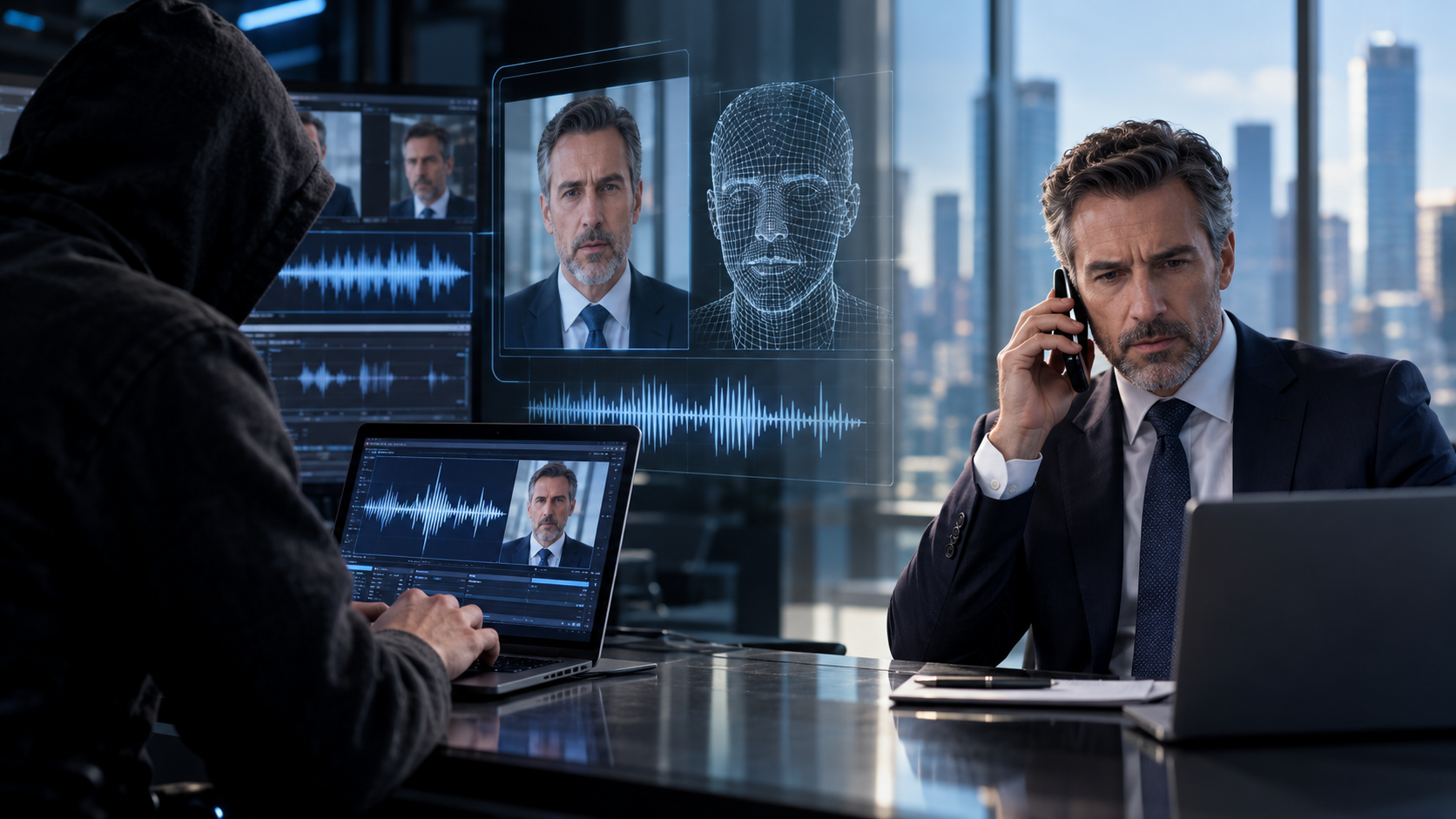
Technological evolution has created a continuum between digital threats and physical risks, rendering any strict separation between the two obsolete. Technologies such as deepfakes and voice cloning allow criminals to impersonate executives with a level of realism that surpasses human detection capabilities, enabling sophisticated fraud, manipulation of employees, and the compromise of critical decision-making processes.
Doxxing—the intentional release of sensitive personal information—is an increasingly prevalent threat vector. An executive whose residential details are published on hostile forums or private channels is exposed not only to online harassment, but also to real-world risks such as intrusion, kidnapping, or assault. Similarly, the sharing of personal routines via family members’ social media can provide adversaries with valuable insights into movements and habits.
Proactive Digital Identity Management
Protecting executives in today’s environment requires an approach that integrates proactive digital identity management with traditional security measures. This includes periodic audits of the executive’s and their family’s digital exposure, systematic removal of sensitive data from data brokers and publicly accessible records, and continuous monitoring of social platforms, forums, the dark web, and compromised datasets to detect new exposures or signs of targeting.
Travel and event planning must also incorporate digital intelligence as a core component: assessing online security conditions related to specific destinations, monitoring localized threats or discussions, and adapting the security posture based on identified signals. This enables protection teams to calibrate resources effectively without resorting to excessive physical deployments.
An Integrated Framework for Executive Security
More advanced organizations are moving toward a protection model that combines digital intelligence, behavioral analysis, and physical security into a unified framework. This approach requires collaboration between corporate security teams, legal departments, IT functions, and specialized intelligence consultants, overcoming the organizational silos that still characterize many corporate structures.
Continuous monitoring of executives’ digital footprints is not a one-time activity but an ongoing process that must be embedded into daily security operations. Early threat indicators—such as unusual spikes of attention on specialized forums, impersonation attempts on social media, or the emergence of personal data in newly compromised datasets—only gain value if they are detected, analyzed, and translated into preventive measures at a pace aligned with the rapid evolution of threats.
Kriptia’s Support
Kriptia provides organizations with an integrated Digital Exposure Audit and intelligence-led protection service for corporate executives. Leveraging its expertise in OSINT and proprietary digital platforms, Kriptia conducts comprehensive mapping of executives’ and their families’ digital exposure, identifies vulnerabilities exploitable by hostile actors, and implements continuous monitoring across open sources, social media, the dark web, and compromised datasets.
The service includes the production of periodic intelligence reports and tailored training for executives and their staff on secure digital identity management. With a global operational network of over 200 qualified professionals, Kriptia ensures coverage that combines digital capabilities with on-the-ground knowledge of local environments and dynamics.